The Rise of the Federalist Society
When Robert Bork’s nomination to the Supreme Court was rejected as a threat to civil liberties, Republicans accused Democrats of applying an ideological litmus test to the nomination process, ignoring that they had done that themselves in selecting Bork. When they next had an opportunity to put forward a nominee, Clarence Thomas became the first of six consecutive Republican nominees groomed and vetted by the Federalist Society to sit on the nation’s highest court.
After Antonin Scalia, Bork was the second Federalist Society member that President Reagan nominated to the Supreme Court. Then-Senator Joe Biden, who was the chair of the Judiciary Committee overseeing the nomination hearing, had cautioned Reagan against nominating Bork.
Reagan, however, was under pressure to nominate someone who would decide cases more reliably for conservatives than the man he would be replacing, Lewis Powell (the same Lewis Powell who had warned of the attack on the US enterprise system). Bork received the nomination, but with Biden framing Bork’s originalist views of the Constitution as a threat to civil liberties, the Judiciary Committee voted against confirmation and the full Senate rejected him by the largest margin, 58-42, of any of the previous 26 failed Supreme Court nominees. Six Republicans joined with 52 Democrats against confirmation; two Democrats voted in favor.
Biden explained his reasoning to the New York Times, “People understand how fragile their liberties are. I believe the American people have a genuine and justifiable fear of government intrusion in what they instinctively know is going to be an ever more intrusive world.”
Conservatives were outraged, declaring that Democrats had used an ideological litmus test against Bork – a declaration amplified through the news media that portrayed the defeat as an underhanded partisan power play by Democrats. In a pattern that would begin to repeat in the years ahead, neither Democrats nor the media seemed to focus on the Republicans’ own ideological litmus test used in selecting Bork for the nomination.
With Bork’s defeat now their rallying cry, one that persists even today, Republicans went all in on the nomination of Thomas, determined to replace the one Black justice on the court, the liberal former civil rights attorney Thurgood Marshall, with a staunchly conservative Black justice whose views were shifting against affirmative action, a target of conservative policymakers.
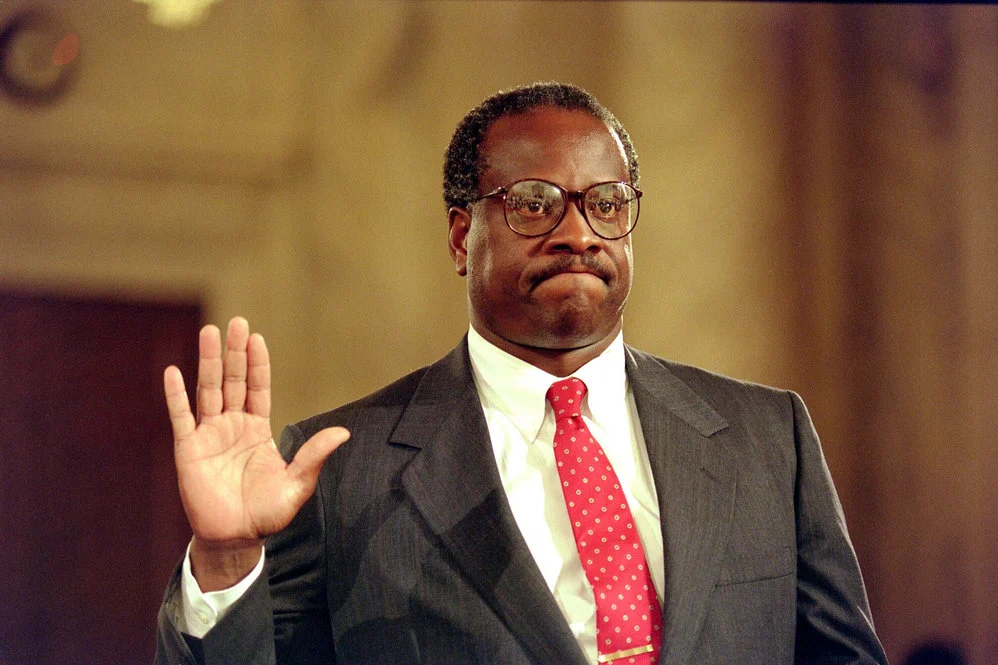
Learning a lesson from the Bork hearings, Thomas was careful to avoid taking any definitive legal positions on controversial issues like abortion during his own confirmation hearings. Nevertheless, he found his nomination in trouble when Anita Hill, one of his former aides, accused him of sexual harassment. Rather than withdraw from consideration, Thomas denied the allegations and ultimately received the votes he needed to be confirmed. He was confirmed by a vote of 52-48, the narrowest margin since 1887, with 11 of 57 Democrats voting in favor.
Thomas’ contentious yet successful nomination to the bench began a decades-long period in which the Federalist Society’s originalist views steadily took root in the judiciary. Nearly half of President George W. Bush’s appointments to the appellate courts were members of or supporters of the Federalist Society, as were his two nominees to the Supreme Court, John Roberts and Samuel Alito. And as noted earlier, most of Trump’s appointments to the appellate courts and all three of his Supreme Court nominees – Neil Gorsuch, Brett Kavanaugh, and Amy Coney Barrett – were Federalist Society members.
With the Court growing more ideologically conservative, it began to check off boxes on the Republicans’ agenda: Citizens United (2010) expanded the influence of money in politics; Shelby County (2013) reduced protections against voter suppression; and Dobbs (2022), eliminated the federal right to abortion. Biden’s concerns about originalism are proving true. Polls have consistently shown that most Americans oppose these results. Nonetheless, they served the three groups in the Reagan coalition who came together to radically change the course of the country: respectively, the business community, the white supremacists, and the religious fundamentalists.