Not long after posting to The American Leader’s Facebook page that Virginia Del. Dan Helmer “wanted to ensure Virginia students learn the truth about January 6”, a commenter asked, “Whose truth?”
Over two decades ago, I watched an episode of the PBS news magazine, NOW, on which Bill Moyers, the venerated newsman, appeared for a moment as a deer in the headlights. That was his shocked response when his guest, Richard Viguerie, a founding father of the modern conservative movement, told him that all journalism was just opinion.
The commenter’s question is a direct outgrowth of Viguerie’s radical declaration.
The issue of “journalism as opinion” is more nuanced than it appears. In a very narrow sense, Viguerie was right. Journalism is an opinion, albeit a well-informed opinion based on multiple pieces of evidence that can logically be connected to form a full picture, within an established framework for understanding the world and how it works. We call such an opinion, or interpretation of the data, “truth”. How credible the truth is depends on the volume and credibility of the evidence and its sources.
This is what stunned Moyers, and it’s where the discussion gets a little wonky: Viguerie’s statement carried an implicit rejection of the almost universally held framework for understanding the world. Humankind’s accumulation of knowledge doesn’t just exist within that framework. It is the framework — our understanding of the laws of physics that make all our human-made technologies possible (whether or not they are good for us), our grasp of human behaviors that enable us to navigate our relationships (for better and worse), and our insights into human consciousness and awareness that help us to know ourselves (more or less).
Our evidence-based journalism (like our evidence-based science) only functions within that framework.
Viguerie’s declaration that it is all just opinion offered insight into the untethering of the once-conservative movement in the country from the established frame of knowledge. It also gave permission for what was to come. What began as Viguerie’s explanation for the extreme partisan bias of Sean Hannity and Fox News evolved over the years into Republican claims of “alternative facts” and “fake news” that led many to believe we were in a post-truth world. And ultimately, it brought about the lies that defy what our eyes plainly see.
Truth, however, persists whether or not we choose to see and accept it. It is independent of our existence and our beliefs. The Earth revolves around the sun, the world is round, the Holocaust happened, climate change is real, and Trump lost the 2020 election. The best available knowledge tells us all these things are true, whether or not we believe them. They will remain true long after we’re gone unless someone can produce evidence — not baseless opinion — to the contrary.
The truth belongs to no one.
So, when the commenter asked, “Whose truth?”, he was asking us to indulge in an unwinnable debate between personal beliefs, with its implicit denial of a common external reality. That’s his prerogative in a free society, but we are equally free to dismiss his question as unproductive. If he instead offered evidence to support an alternative explanation of the events of January 6, we would be obligated to engage in discussion.
The question of who owns the truth is unmoored from the human relationship to knowledge and presents a threat to our ability to govern ourselves. To quash the threat, all of us, and especially journalists, need to more effectively assert what we know, acknowledge gaps in our knowledge, and apply new insights that will enable our communities to thrive and strengthen the bonds of our democracy.
We can and should question and debate these things to improve our knowledge and what we do with it, provided we rely on evidence and not opinion and lies to carry the debate forward.
Language is easily corrupted and meaning subverted through misuse, out-of-date descriptions, implicit meaning, and a variety of other mechanisms, whether intentional or not. Our “Just Words” series explores how that can impact what people see through the window journalism and media provide.
Author: George Linzer
Published: June 5, 2026
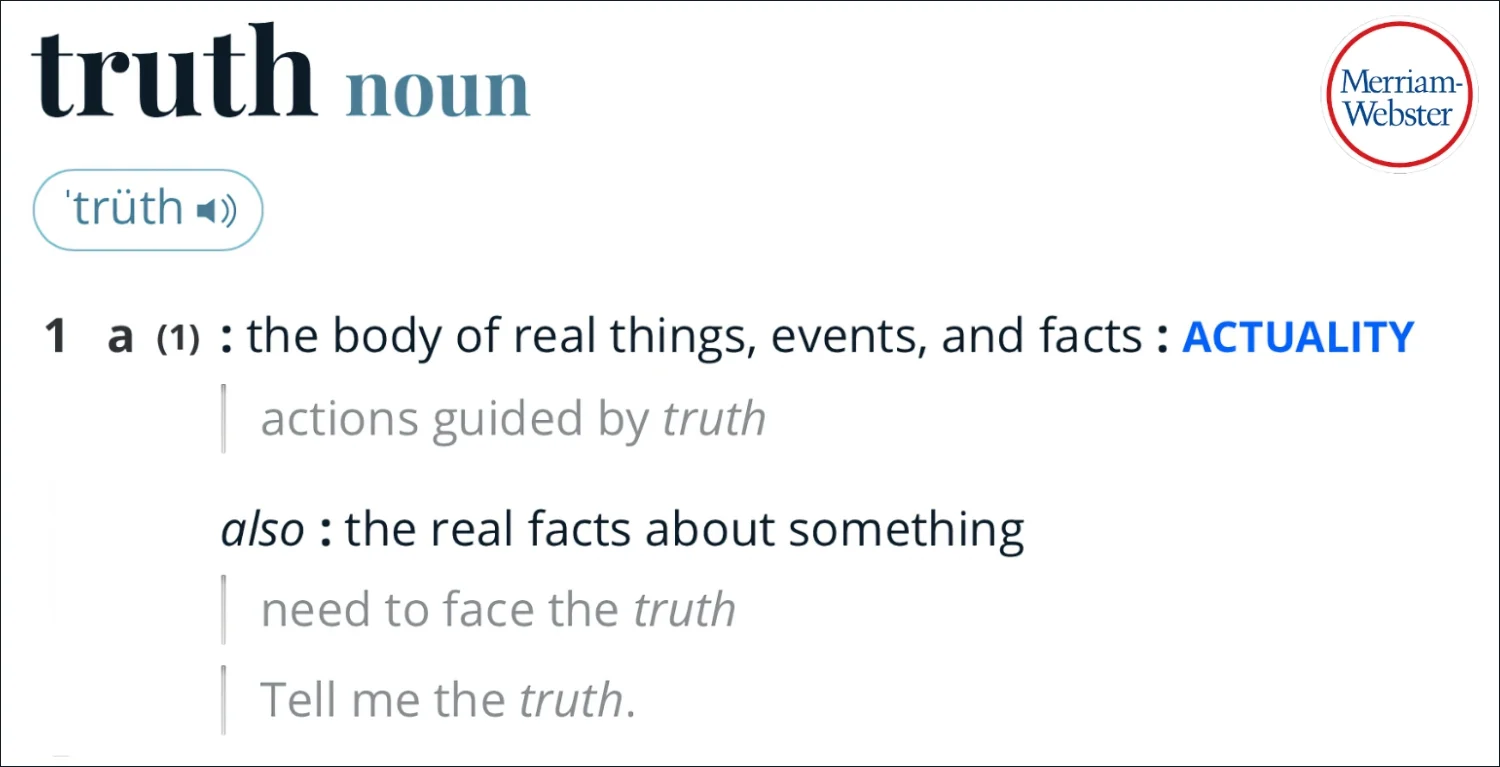
Feature image: Adapted from Merriam-Webster